
FROM EXAMINATION To Grant
Patent Prosecution
Strategic prosecution addresses objections, refines the application and moves it towards grant.
AFTER FILING
The Application Sets the Boundaries.
Prosecution addresses examination findings while preserving the strongest supportable claim scope.
Filing begins the process. Examination tests the application against patentability requirements and the prior art identified by the patent office.
THE EXAMINATION CYCLE
From Office Action to Response.
Patent prosecution is a structured exchange with the patent office, addressing examination findings and advancing the application towards resolution.
01
EXAMINE
Review the Objections
02
EVALUATE
Define the Response
03
RESPOND
Address the Issues
Prepare focused submissions supported by the application and relevant patent law.
04
ADVANCE
Move the Application Forward
Manage further examination and requirements towards grant.
RESPONDING TO EXAMINATION
Not Every Objection Requires the Same Response.
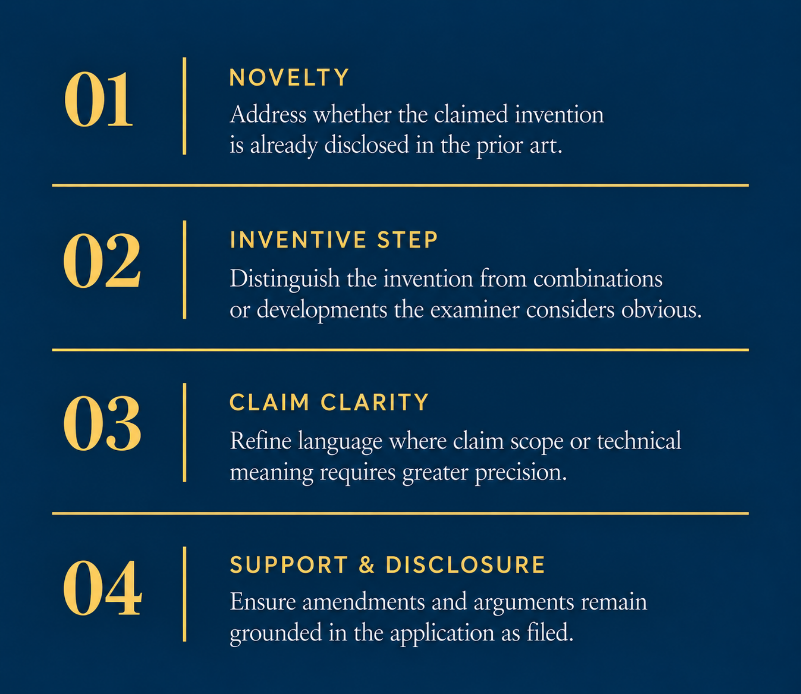
The response should match the objection, addressing the examiner’s findings without unnecessarily narrowing the invention’s commercial or technical value.
BEFORE SUBMISSION
Arguments, Amendments or Both.
Effective prosecution requires deciding what to defend, what to refine and where amendment could unnecessarily narrow the claims.
PRESERVING CLAIM SCOPE
Every Amendment Has a Consequence.
Amendments can advance prosecution, but may also narrow protection. Each change should address the objection while preserving supportable and commercially relevant scope.
NECESSITY
mend Only Where Needed
Avoid limitations that do not materially advance the application.
SUPPORT
Stay Within the Disclosure
Ground every amendment in the application as originally filed.
SCOPE
Consider What Changes
Assess how revised language affects the boundaries of the claims.
COMMERCIAL VALUE
Protect What Matters
Preserve claim coverage around the features carrying technical and commercial significance.
A claim that is allowed but unnecessarily narrowed may protect less than the invention warrants.
THROUGHOUT PROSECUTION
The Application Must Stay Aligned.
Prosecution can change the claims and arguments, but each step must remain anchored to the application as filed.
CLAIMS
Maintain Consistency
Keep revised claims aligned with the technical disclosure and positions taken during prosecution.
AMENDMENTS
Preserve Support
Ensure each change remains supported by the application as filed.
ARGUMENTS
Build a Clear Record
Present positions consistently across responses and examination stages.
DISCLOSURE
Keep the Foundation Intact
Maintain a clear connection between the protection pursued and the invention originally disclosed.
WHEN PROSECUTION EVOLVES
Know When to Change Course.
Effective prosecution is not persistence at any cost. It is knowing which position to preserve, refine or pursue differently.
01
CONTINUE
Maintain the Position
Continue argument where the claims remain technically and legally supportable.
02
REFINE
Adjust the Position
Reframe claim language where a targeted amendment can move prosecution forward.
03
ENGAGE
Clarify the Issues
Use available examiner engagement where direct discussion may help narrow or resolve outstanding points.
04
REASSESS
Consider the Next Route
Evaluate further prosecution, review or appeal where substantive issues remain unresolved.
ACROSS PATENT OFFICES
One Invention. Different Examination Paths.
Patent offices may raise different prior art, objections and requirements. Prosecution must adapt without losing sight of the broader patent position.
OFFICE PRACTICE
Respond to the Jurisdiction
Adapt the prosecution approach to the substantive and procedural requirements of each patent office.
RELATED CASES
Keep the Family in View
Consider positions taken in corresponding applications when shaping claims and arguments.
CLAIM STRATEGY
Manage Scope Across Markets
Pursue claim scope appropriate to each jurisdiction while maintaining strategic coherence.
PROSECUTION RECORD
Maintain Consistency
Different offices may require different responses. The underlying protection strategy should remain coherent.
Different examination paths should not result in a fragmented patent strategy.
TOWARDS GRANT
Allowance is Not the Only Measure.
Successful prosecution is not simply about reaching grant. The protection secured should remain relevant to the invention, its commercial value and the wider patent position.
The objective is not simply a granted patent. It is protection with continuing value.
01 CLAIM SCOPE
Protect the Right Ground
02 PROSECUTION RECORD
Build a Clear Record
Maintain a considered record of the arguments and amendments leading to allowance.
03 PORTFOLIO FIT
Keep the Wider Position in View
Consider how the granted claims sit alongside related applications and rights.
04 POST-GRANT VALUE
Think Beyond Allowance
Preserve protection that can support commercialisation, licensing and enforcement.
Frequently Asked, Clearly Answered
01. What is patent prosecution?
Patent prosecution is the process of advancing a patent application through examination, including responding to objections, addressing prior art and amending claims where appropriate.
02. What is an office action?
An office action is a communication from a patent office identifying objections, requirements or grounds that must be addressed before the application can progress.
03. Does every office action require claim amendments?
No. Depending on the objection, the appropriate response may involve argument, amendment, clarification or a combination of these.
04. Can claims be amended during prosecution?
Yes, subject to applicable rules. Amendments must remain supported by the application as filed and should be considered carefully for their effect on claim scope.
05. How long does patent prosecution take?
Timelines vary by jurisdiction, technology, examination complexity and the number of examination rounds required.
06. Can the same prosecution strategy be used in every country?
Not necessarily. Patent offices apply different laws, examination practices and procedural requirements, requiring the strategy to be adapted by jurisdiction.
07. What happens if an examiner maintains an objection?
Further argument, amendment, examiner engagement, review or appeal may be available, depending on the jurisdiction and stage of prosecution.
08. What happens once the patent is granted?
Post-grant requirements vary by jurisdiction and may include grant formalities, renewal or maintenance fees and ongoing portfolio management.
Keep the Application Moving.
From examination through response, amendment and grant, each step can shape the protection ultimately secured.