
IP LICENSING AGREEMENTS
Structure the Rights. Secure the Value.
We structure and negotiate intellectual property licensing agreements that define usage rights, royalties and commercial obligations, protecting IP assets while enabling their commercial value.
THE COMMERCIAL PERSPECTIVE
Turning Intellectual Property into Commercial Value.
Retain ownership. Unlock commercial value
Intellectual property licensing enables businesses to generate revenue from their IP assets while retaining ownership. A carefully structured agreement establishes the scope of permitted use, royalty arrangements and contractual safeguards, ensuring commercial opportunities are pursued without compromising proprietary rights.
OUR APPROACH
Licensing Built Around Commercial Objectives.
Our approach combines legal precision with commercial insight to establish clear licensing rights, balanced obligations and effective contractual protections.
01
RIGHTS & OWNERSHIP
Establish licensed IP assets, ownership rights and permitted use.
02
LICENSING STRUCTURE
Define exclusivity, territorial scope, sublicensing rights and duration.
03
COMMERCIAL TERMS
Structure royalties, payment obligations and performance requirements.
04
CONTRACTUAL SAFEGUARDS
Address quality control, compliance, termination and post-termination rights.
Clear rights. Balanced terms. Protected value.
LICENSING STRUCTURES
The Right Licence for Every Commercial Arrangement.
Licensing arrangements vary according to the nature of the intellectual property, intended use and commercial objectives. We advise on structures that balance commercial flexibility with appropriate control over IP rights
EXCLUSIVE LICENSING
Grant exclusive rights to a single licensee within an agreed territory, field of use or other defined scope.
NON-EXCLUSIVE LICENSING
Permit multiple licensees to use the same IP under separately defined contractual arrangements.
SOLE LICENSING
Grant rights to one licensee while retaining the licensor’s own right of use.
CROSS-LICENSING
Establish reciprocal licensing arrangements between parties holding intellectual property rights.
Defined Rights. Commercial Flexibility. Protected Interests.
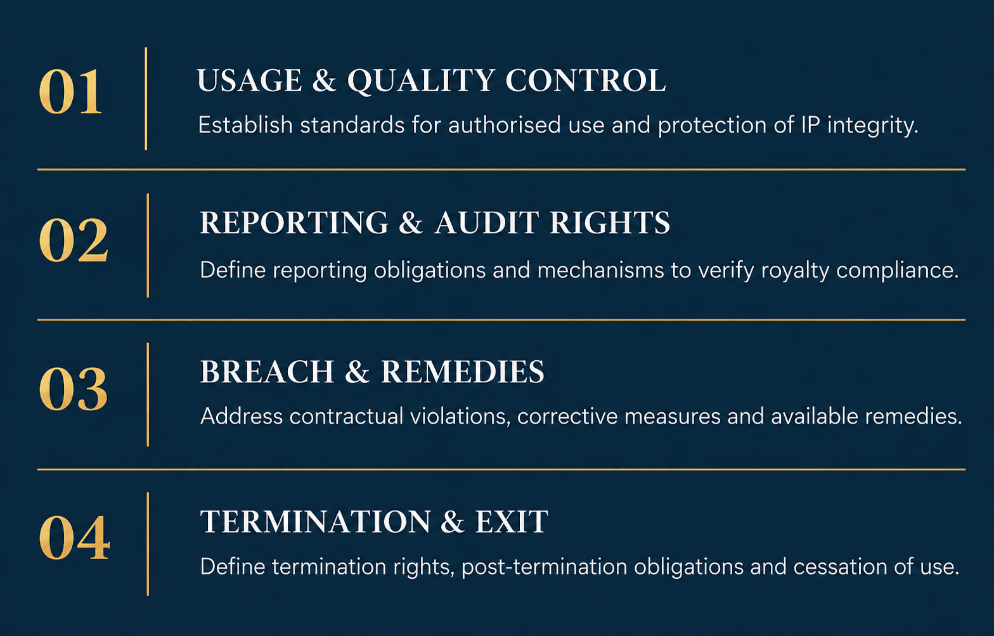
CONTRACTUAL SAFEGUARDS
Protecting Rights Beyond the Agreement.
Effective IP licensing requires clear safeguards against misuse, non-compliance and unauthorised exploitation. We structure contractual protections to preserve ownership and commercial value.
Protect the rights. Preserve the value.
ENFORCEMENT ASSESSMENT
Understand the Risk. Define the Response.
Every infringement presents different risks and commercial implications. We assess the strength of IP rights, the nature of the infringement and the available enforcement options to establish a clear course of action.
Assess the rights. Understand the exposure. Define the response.
01 RIGHTS ASSESSMENT
Evaluate the scope, validity and enforceability of the intellectual property rights involved.
02 INFRINGEMENT ANALYSIS
Examine the suspected infringement, available evidence and potential exposure.
03 COMMERCIAL IMPACT
Assess business risks, market implications and the potential consequences of enforcement.
04 ENFORCEMENT OPTIONS
Identify proportionate responses based on legal considerations, commercial priorities and desired outcomes.
LICENSING NEGOTIATION & EXECUTION
From Negotiation to Effective Licensing.
We guide licensing arrangements from commercial negotiations through contractual finalisation, execution and implementation, ensuring clarity of rights, obligations and agreed terms
Agreed terms. Defined obligations. Effective implementation.
Frequently Asked, Clearly Answered
01. What is an intellectual property licensing agreement?
An IP licensing agreement permits another party to use specified intellectual property under agreed conditions while ownership remains with the licensor.
02. What types of intellectual property can be licensed?
Trademarks, patents, copyrights, industrial designs, software, technology and confidential know-how may be licensed, subject to applicable rights and laws.
03. What is the difference between exclusive and non-exclusive licensing?
An exclusive licence grants rights to one licensee within an agreed scope, potentially restricting the licensor’s own use. A non-exclusive licence allows the licensor to grant similar rights to other parties.
04. How are royalties structured in IP licensing agreements?
Royalties may be based on fixed fees, sales percentages, usage, milestones or a combination of payment structures, depending on the commercial arrangement.
05. Can an IP licensing agreement cover multiple countries?
Yes. Licensing agreements can cover specific countries, regions or multiple territories, subject to the scope of IP protection and applicable laws.
06. What happens if a licensee breaches the agreement?
Depending on the contractual terms and applicable law, remedies may include corrective action, damages, suspension or termination of licensing rights.
07. Can an IP licensing agreement be terminated?
Yes. Agreements may provide for termination upon expiry, material breach, mutual agreement or other specified events, subject to contractual conditions and applicable law.
Put Your Intellectual Property to Work.
We structure IP licensing agreements to protect ownership, define commercial rights and maximise long-term value.